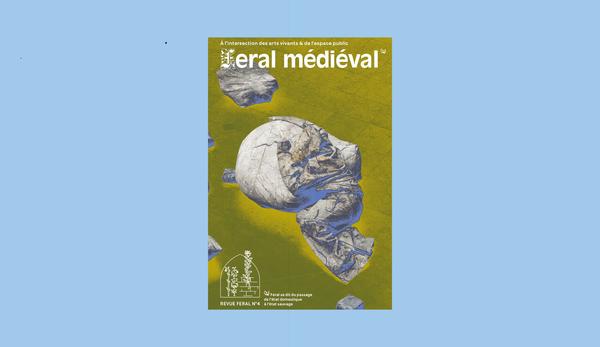
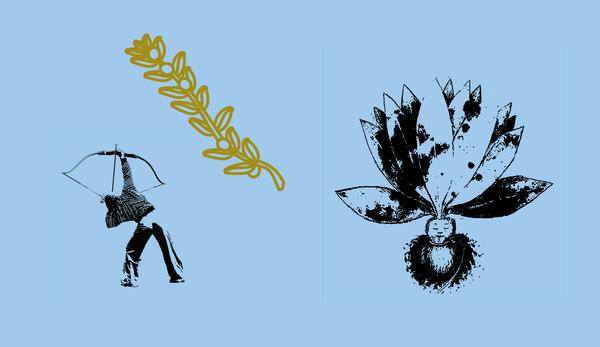
Bienvenue dans le tout nouveau numéro de la Revue Feral : Feral Médiéval. Sur sa couverture, un moine est en pleine sieste vigorifiante. Ou bien est-ce un·e astronaute qui fait un hug à une comète ? Ou peut-être un continent qui se déplace sans considération aucune pour les frontières ? Pour sûr, c’est une tentative de connexion avec un temps long : celui des pierres à ré-aiguiser à l’infini. Une envie de flotter dans des PAYSAGES RALENTIS, titre de la performance de Moni Wespi.
Feral Médiéval est une plongée dans le Moyen Âge à travers les pratiques artistiques qui explorent son pouvoir émancipateur, pour le faire briller au-delà de sa mauvaise réputation.
Quelles ressources les artistes voient-iels dans le médiéval ? Quels imaginaires précoloniaux et précapitalistes sont convoqués ? Quelles bifurcations artistiques, politiques, historiques font-iels entrapercevoir ? Ces questions ont animé les interventions des artistes, historien·nes et expérimentateur·ices invité·es lors de Feral 2025.
Retrouvez les contributions d’Amalia Laurent, aniara rodado & Martin Howse, Aurel Leforestier, Bryana Fritz & Stefa Govaart, Chloé Deligne, Clara Thomine, Clovis Maillet, Eden Tinto Collins, fede fantini, Anna Czapski & Diederik Peeters / Futurology of Cooperation, Giulia Piana & Chiara Monteverde / Micha’s Amateur Theater Group, La Guilde Royale Saint Sébastien de Schaerbeek, McCloud Zicmuse, Moni Wespi, Ondine Cloez & Viviane Genest, Open Source Publishing, Pierre-Olivier Dittmar, Rita Fenendael, Simona Denicolai, The Aunties, Toestand et Yohanan JB Lefebvre.
Dans cette traversée, vous rencontrerez aussi Jane Dark, des béguines enflammées, une agence pour familles élargies, une île où s’organiser contre l’endiguement, des crèmes pour voler… et bien d’autres formes et tactiques où le médiéval est un terrain de lutte et d’expérimentation.
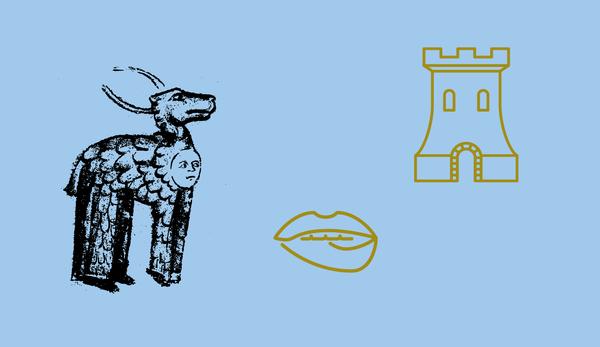
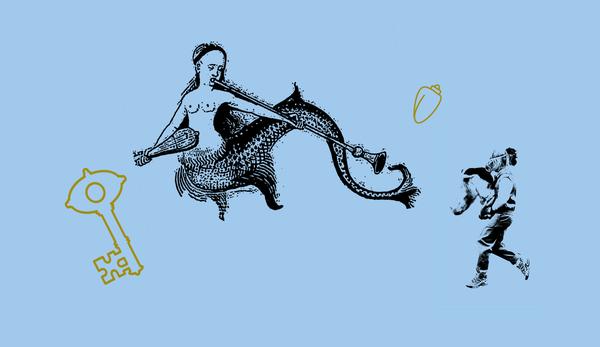
Vos guides ? Des symboles, des blasons, et bien sûr l’enthousiasme de l’équipe éditoriale : Leslie Doumerx (rédaction en chef), Lucie Caouder & Nina Saulier (graphisme) et Flore Herman (édition).
Gratuite, la Revue Feral n°4 est maintenant disponible en français et en anglais sur la Cifasothèque. Vous pouvez aussi vous procurer un exemplaire papier à l’accueil de La Bellone (Rue de Flandre 46, 1000 Bruxelles).
(image : Cifas)
Chap. 1 Faire batailler les imaginaires
La puissance du médiéval dans l’imaginaire collectif contemporain
L’historien Pierre-Olivier Dittmar en mesure l’ampleur. Pour lui, « le Moyen Âge a changé » et il traverse toute la société occidentale (p.8).
L’historien de l’art et performeur Clovis Maillet sonde le milieu de l’art contemporain et ses écoles, et observe les relations - ambivalente, fantasmée, militante - qu’entretiennent les artistes avec le médiéval (p.13).
Eden Tinto Collins, trobairitz DIY multi talents, prend la plume pour écrire le scénario du prochain épisode de sa série, A Pinch of Kola. Son alter ego Jane Dark y fera une rencontre mémorable (p.18).
Les graphistes d’Open Source Publishing reviennent sur leur pratique de création collective de blasons : une négociation visuelle qui, lorsqu’on essaie de créer de nouveaux communs, confronte le besoin d’appartenance à la nécessité de s’émanciper… et vice versa (p.24).
(image : Cifas)
Chap. 2 Bifurquer vers des nouveaux communs
Expérimentations de pratiques pour faire communauté
Ce chapitre entame une traversée de Bruxelles : du Parc Josaphat à l’ancien couvent du MONA se suivent praticien·nes et spécialistes des jeux et des guildes tel·les que Chloé Deligne (p.32) et La Guilde Royale Saint-Sébastien (p.30) ; l’amatrice de processions Amalia Laurent (p.35); des expérimentateur·ices de l’amour et des communs tel·les que Rita Fenendael (p.42), et Bryana Fritz & Stefa Govaart (p.44), et une très très grande famille élargie qui s’organise en agence, The Aunties (p.47), pour accueillir de nouveaux membres.
(image : Cifas)
Chap. 3 Réensauvager les savoirs
Revenir aux racines et eaux prémodernes
D’abord, un retour sur le workshop d’Ondine Cloez & Viviane Genest par le dramaturge Aurel Leforestier : une tentative de penser-plante, nourrie par des textes médiévaux où humain et végétal sont liés « par la racine » et unis dans une même cosmologie (p.52).
Ensuite, aniara rodado conjure l’épistémicide, l’éradication systématique de savoirs non reconnus par la science occidentale. Elle partage une bribe de sa recherche autour de « la crème pour voler » : un onguent qui a survécu aux chasses aux sorcières (p.56).
Puis, fede fantini partage deux pages de son carnet de recettes, des décoctions et infusions, comme une invitation à préciser nos intentions dans cette transmission de savoirs (p.60).
Pour la fin, tout vole en éclats imaginaires, puisque nous pouvons revenir en arrière et… réécrire la suite ! C’est ce que proposent Anna Czapski et Diederik Peeters, à travers un jeu de rôle coopératif rétrofuturiste : un trip sur l’île de Testerep du 12ème siècle, menacée par le projet de poldérisation des moines entrepreneurs (p.62).
Voici donc cette traversée retrofuturomédiévale partagée version express
Sankofa (p.19), cet oiseau au cou replié vers le passé, qui donne conseil à Jane Dark depuis la tradition Baoulé, dirait : « Il n’est pas tabou de revenir chercher ce que l’on a oublié ».
Nous espérons que vous n’en aurez pas attrapé de torticolis et que vous pourrez retendre le cou bien en avant pour les luttes et expérimentations à venir. Une fois la 4ème de couverture refermée bien sûr !
Welcome to this new issue of Feral Magazine: Feral Medieval. On the cover, a monk is enjoying a refreshing nap. Or is it an astronaut giving a comet a hug? Or perhaps a continent drifting along with no regard for borders… Certainly, it is an attempt to connect with a long stretch of time: that of stones we sharpen endlessly. A desire to float through SLOWED LANDSCAPES, title of a performance by Moni Wespi.
Feral Medieval dives into the Middle Ages through artistic practices that explore this period’s emancipatory power, allowing it to shine beyond its tarnished reputation.
What resources do artists see in the medieval period? What pre-colonial and pre-capitalist imaginaries do they invoke? What artistic, political and historical divergences do they show us? These questions nourrished the contributions of artists, historians and researchers invited to Feral 2025.
Discover contributions by Amalia Laurent, aniara rodado & Martin Howse, Aurel Leforestier, Bryana Fritz & Stefa Govaart, Chloé Deligne, Clara Thomine, Clovis Maillet, Eden Tinto Collins, fede fantini, Anna Czapski & Diederik Peeters / Futurology of Cooperation, Giulia Piana & Chiara Monteverde / Micha’s Amateur Theatre Group, La Guilde Royale Saint Sébastien de Schaerbeek, McCloud Zicmuse, Moni Wespi, Ondine Cloez & Viviane Genest, Open Source Publishing, Pierre-Olivier Dittmar, Rita Fenendael, Simona Denicolai, The Aunties, Toestand and Yohanan JB Lefebvre.
On this journey, you will also encounter Jane Dark, fiery Beguines, an agency for extended families, an island where people are organising against containement, flying creams, and many other forms and tactics in which the medieval is a terrain of struggle and experimentation.
Your guides? Symbols, coats of arms, and of course the enthusiasm of the editorial team: Leslie Doumerx (editor-in-chief), Lucie Caouder & Nina Saulier (graphic design) and Flore Herman (head of publishing).
Feral Magazine n°4 is now available, for free, in French and English on the Cifasotheque. You can also pick up a paper copy at the reception desk of La Bellone (Rue de Flandre 46, 1000 Brussels).
(image : Cifas)
Chap. 1 When Imaginaries Collide
The power of the medieval in contemporary collective imagination
The historian Pierre-Olivier Dittmar assesses the scale of the phenomenon. In his view, “the Middle Ages have changed” and this shift permeates the whole of Western society (p.8).
Art historian and performer Clovis Maillet explores the contemporary art scene and its schools, observing the ambivalent, fantasised and militant relationships that artists maintain with the medieval (p.13).
Eden Tinto Collins, a multi-talented DIY trobairitz, puts pen to paper to write the script for the next episode of their series, A Pinch of Kola, in which their alter ego, Jane Dark, will make a memorable encounter (p.18).
The graphic designers at Open Source Publishing reflect on their practice of collectively creating coats of arms: a visual negotiation which, when attempting to create new commons, pits the need for belonging against the necessity of emancipation… and vice versa (p.24).
(image : Cifas)
Chap. 2 Branching Out Towards New Commons
Experiments in community-building practices
This chapter begins a journey through Brussels: from Josaphat Park to MONA (a former convent), we encounter practitioners and specialists in games and guilds such as Chloé Deligne (p.32) and the Royal Guild of Saint Sebastian (p.30); procession enthusiast Amalia Laurent (p.35); experimenters in love and the commons such as Rita Fenendael (p.42), and Bryana Fritz & Stefa Govaart (p.44), and a very, very large extended family organised as an agency, The Aunties (p.47), to welcome new members.
(image : Cifas)
Chap. 3 Rewilding Knowledge
Back to the roots and pre-modern waters
First, a look back at the workshop led by Ondine Cloez and Viviane Genest, as described by the dramaturg Aurel Leforestier: an attempt at “thinking [as] plant”, drawing on medieval texts in which humans and plants are linked “by the root” and united within the same cosmology (p.52).
Next, aniara rodado warns against epistemicide, the systematic eradication of knowledge not recognised by Western science. She shares an extract of her research on “flying cream”: an ointment that survived the witch hunts (p.56).
Then, fede fantini shares two pages from their recipe book, featuring decoctions and infusions, as an invitation to clarify our intentions in this transmission of knowledge (p.60).
Finally, everything shatters into imaginary pieces, as we can go back in time and… rewrite what comes next! This is what Anna Czapski and Diederik Peeters propose, through a retrofuturistic cooperative role-playing game: a trip to the 12th-century island of Testerep, threatened by the land reclamation project of entrepreneurial monks (p.62).
There you go, an express version of this retrofuturistic medieval journey
Sankofa (p.19), a bird from the Baoulé tradition with its neck bent backwards, who offers Jane Drak guidance, would say: “It is not taboo to go back and retrieve what we have forgotten”.
We hope you haven’t caught a stiff neck, and that you will be able to stretch your neck out long towards the struggles and experiments to come. Once you’ve closed this publication of course!